
Straße & Platz Landmark
Kleine & Große FreiheitWhatsAppE-MailKleine & Große Freiheit
History & Meaning
The streets Große FreiheitKleine Freiheitreligious and commercial freedoms were allowed. This was in sharp contrast to strictly Lutheran Hamburg.
In this “Freiheit” district, Catholics, Reformers, and Mennonites could build churches, and craftsmen outside the guilds could work freely. For Altona, backed by the Danish crown, it was a strategy to grow and compete with Hamburg — while for Denmark, it was a way to establish a counterweight to the Hanseatic city.
Border Stones & City Limit
Today, you can still find border stones marked “A” and “H”, reminders of the old frontier between Altona and Hamburg. One such stone, inscribed “A | H,” stands at the intersection of Thadenstraße and Grüner Jäger. Many date from the 19th century, when granite markers replaced older wooden posts.
Along Schulterblatt street, some stones with “A” and “H” are even set into the pavement, subtle markers of the former boundary.
Altona’s Independent Spirit
For centuries, the Freiheit streets embodied Altona’s independence. While Hamburg enforced rigid rules, Altona — supported by the Danish crown — chose openness and tolerance. The name “Freiheit” itself tells a story of both civic liberty and clever power politics in the Danish-Holstein context.
Address
Loading the map will transfer data to OpenStreetMap.
Nearby
-
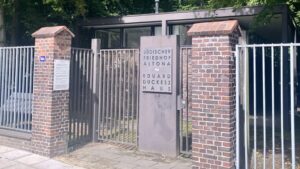 Gedenkort Jüdischer Friedhof Altona
500 m entfernt
-
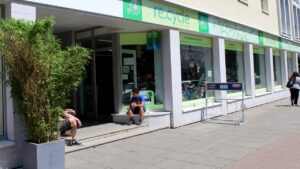 Fahrradladen re.cycle – der soziale Radladen
600 m entfernt
-
 Fitnessgeräte HAMMER Fitness
700 m entfernt
-
 Baumarkt hagebaumarkt Altona
800 m entfernt
-
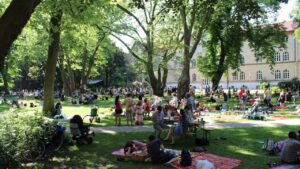 Stadtteilzentrum HausDrei
900 m entfernt
-
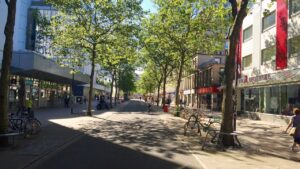 Initiative & Verein Stadtteilrat Altona-Altstadt
900 m entfernt